Applying HB Pairs Analysis to the Paul Reed Smith 513 Guitar

Applying Humbucking (HB) Pairs Analysis to the Paul Reed Smith 513 Guitar

© 2016 Don Baker dba android originals LC, Tulsa OK

The Paul Reed Smith PRS-513 guitar, a beautiful, awesome-sounding guitar, boasts a 3-way and a 5-way switch to control two dual-coil humbuckers at the bridge and neck, with a single-coil pickup at the middle position, for a total of 5 coils  Of the 15 choices, three of them are the middle single-coil pickup and thus the same, so it acknowledges that there are 13 different choices.  Hence, if I understand correctly, the 513 designation, 5 coils with 13 different outputs.  The 3 outputs with the middle coil alone are not humbucking.

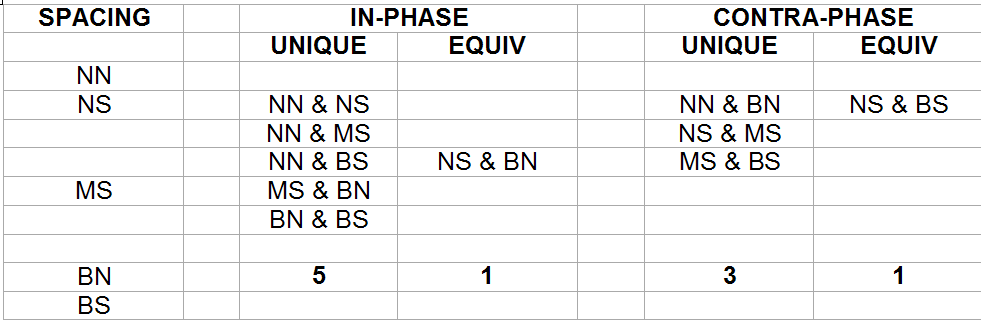
This article will analyze what kind of HB pairs the same 5 coils could produce.  Consider the neck humbucker as two coils NN (neck north up) and NS (neck south up).  Suppose that the middle coil has a south pole up, which would make it MS.  Consider the bridge humbucker as BN and BS.  Because NN is so close to NS, and BN is so close to BS, some humbucking pair combinations will have little difference in tone from others.  In the table below, the left-most column shows the supposed relative physical order of the single-coil poles in space, the middle columns show the in-phase HB pairs, with equivalent HB pair just to the right.  The right columns show the contra-phase HB pairs, with any pairs with equivalent tones just to the right.

2016-07-13 PRS-513 HB analysisAs humbucking pair theory predicts, there are 10 HB pairs, but because the close spacing of the coils at the neck and bridge, 2 of those pairs are essentially equivalent to 2 others, leaving 8 pairs with unique tonal outputs, which can be connected either in series or parallel, for a total of 16 HB pairs with unique tonal outputs out of 20.

Legal notice – The switching system for HB pairs is protected under U.S. patent pending 2016/0027422 A1, filed 7/23/2014, and an undisclosed U.S. Provisional Patent Application, filed 6/28/2016.

Posted in News, Patent news, Press Release, Tutorial | Tagged , , , , | Leave a comment

Applying HB Pairs Analysis to the Music-Man St. Vincent Guitar

Applying Humbucking (HB) Pairs Analysis to the Music-Man St. Vincent Guitar

© 2016 Don Baker dba android originals LC, Tulsa OK

The Music-Man St. Vincent guitar uses a five-way switch to chose among three mini-humbuckers, positioned at the neck, middle and bridge.  The coils in each humbucker are wired in series, producing a stronger, warmer tone that would a parallel-coil connection.  In order (which way I forget), the switch chooses bridge, middle, neck, bridge || middle || neck, and bridge || neck, where “||” means in parallel.

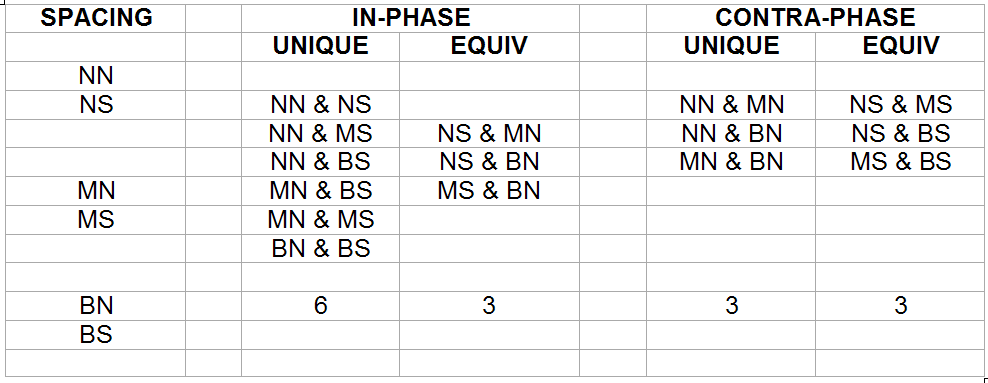
This article will analyze what kind of HB pairs the same 6 coils could produce.  Consider the neck humbucker as two coils NN (neck north up) and NS (neck south up).  Consider that the middle humbucker to be MN and MS, and the bridge humbucker as BN and BS.  Because NN is so close to NS, MN is so close to MS, and BN is so close to BS, some humbucking pair combinations will have little difference in tone from others.

In the table below, the left-most column shows the supposed relative physical order of the single-coil poles in space, the middle columns show the in-phase HB pairs, with equivalent HB pair just to the right.  The right columns show the contra-phase HB pairs, with any pairs with equivalent tones just to the right.

2016-07-03 St Vincent HB pair analysis copy

As humbucking pair theory predicts, there are 15 HB pairs, but because the close spacing of the coils at the neck, middle and bridge, 6 of those pairs are essentially equivalent to 6 others, leaving 9 pair with unique outputs, which can be connected either in series or parallel, for a total of 18 HB pairs with unique tonal outputs, out of 30.

Legal notice – The switching system for HB pairs is protected under U.S. patent pending 2016/0027422 A1, filed 7/23/2014, and an undisclosed U.S. Provisional Patent Application, filed 6/28/2016.

Posted in News, Patent news, Press Release, Tutorial | Tagged , , , , , | Leave a comment

Addendum to An All-Humbucking 5-Way Superswitch Circuit (Tutorials page)

Addendum 2016-06-30:

Actually the odd coil out can be put in any position, not just the middle.  But then you will have to rework the wiring and soldering diagrams.  Consider putting it at the neck.  Then the (N+B) pair is in phase and should have an even warmer tone than the (N+M) pair presented here.  And the (M||B) or even the (M+B) pair will have an even brighter tone than the (N||B) pair presented here.  But I recommend the (M+B) pair if the odd coil is at the neck, because the (M||B) pair will probably be very weak.

If you put the odd coil out at the bridge position, then the contra-phase N and M pairs for that position will be warmer than the contra-phase N and B pairs for the odd coil at the middle position, being farther from the bridge, or maybe brighter, being closer together.  The rules stated in General Principles of Humbucking Pairs may very well tend to cancel each other out, producing smaller differences in tone.  Because their midpoints are in the same position, the M and B in-phase pairs will be the same tone for either the odd coil in the middle or bridge position.  So any setup has to be tested and verified.

I presented the odd coil in the middle here merely because that is the way I first wired it up, leaving the coils where Fender put them.  Sometimes coils are made in different widths for different positions, the better to match the strings.  You may find, BTW, that the standard Strat coils are not matched, and will not produce perfect humbucking.  Mine weren’t.  The reasoning may be that the bridge coil needs some extra output to keep up in volume with the others.  Or it may be looking for a particular tone.

I think you might get an even wider range of tones by putting the odd coil at the neck.

I also took some $6 generic coils with ceramic magnets and attempted to change the polarity with a very strong rare earth magnet.  The polarity did change, but maybe not as strong as the original way.  It needs some work.

Posted in News, Patent news, Tutorial | Tagged , , , | Leave a comment

Paul Reed Smith Guitars 513 ™ model pickup switching – General principles of humbucking pairs

If you go to the PRS Guitars web site and look at the video for the 513 model (five pickups, 13 different sounds) you will see and hear a beautiful guitar that sounds awesome.  It uses two dual-coil humbuckers at the neck and bridge, and a single-coil pickup in the middle.  Apparently the PRS-513 switching system also treats the humbuckers as single-coil pickups.

If it used different switches, it could have 20 unique humbucking outputs from five single-coil pickups, taken in parallel and serial humbucking pairs.  But the two humbuckers put their coils very close together, which might cause some of the outputs to have less tonal distinction.  There are several general principles that apply to the tonal quality of humbucking pairs (all other things being equal):

  1. Pairs closer to the bridge are brighter than those closer to the neck
  2. Pairs closer together are brighter than those farther apart
  3. Parallel-connected pairs are weaker and brighter than series-connected pairs
  4. Counter-phase (out-of-phase) pairs are brighter and weaker than in-phase pairs
  5. Rules 1-4 can interfere with each other
  6. You can only put so many pickups between the neck and the bridge, and the more you have, the smaller the tonal differences in adjacent pairs with the same connections.


Posted in News, Patent news, Press Release, Tutorial | Tagged , , , , , , , , , | Leave a comment

Provisional Patent Application filed on humbucking switch system

On June 27th, shortly after posting about the alleged Fender Marauder ™ hum problem, I figured out just how to solve it with two commonly available switches, in a way that can produce all 12 possible humbucking combinations of pairs of the four single-coil pickups.  Assuming those pickups are matched.  I spent all day on the 28th, writing up a technical document and filed it that evening with the U.S. Patent and Trademark Office (USPTO) as a Provisional Patent Application (PPA).  The switches can be wired to produce the combinations in any order, including from warmest tones to brightest.

I shall not hold my breath waiting for Fender to call.  For one thing, my phone number does not appear on this site.  Second, an 8000-pound gorilla does not call little people.  From what I’ve heard from a recent attendee to its music store dealer boot camp, it even talks down to them.

Posted in Humor/Satire, News, Patent news, Press Release | Tagged , , , , , , , , | Leave a comment

Electronic Freedom for who?

One of the posters on /r/guitar/, a gentleman (a real one) who advocates for Electronic Freedom (EFF) and Open Source (FOSS), noted that an entire geek faction believes that all software should be free of any copyright or patent protection.  It occurs to me that maybe few of those people have any disabilities.

If they did, they might find that the Supreme Court of the United States has rendered decision after decision holding that business does not have to put up with (accommodate) people with disabilities.  The opinions in Toyota v. Williams (2002), for example, were especially tortured.  If a business merely decides that any person with a disability interferes with a business necessity, it may freely fire that person.  People with psychiatric disabilities, even just bad dreams, have it even worse.  If they open their mouths, they can be summarily fired for being “a danger of violence in the workplace” without any history or intention of violence.  Can you say “bigot”?

This leaves most people with disabilities unable to find work, with many attempting to create jobs for themselves.  So imagine this – an unemployed person with a disability works for months or years to develop intellectual property to sell in the marketplace or license to manufacturers.  Then somebody who has little or no impediment to employment comes along and claims, in righteous outrage, that he should have all that hard work for free.

I lost my last job in 2001 or ’02, soon after the USDA came out with training modules that identified anyone with a mental illness as a danger of violence in the workplace.  By that time, I had been living with depression and PTSD for about 50 years, with little or no history of violence or drug abuse, the major risk factors for future violence.  Never mind the injuries from a drinking driver in 1985 that cut down on working full time.

Not being allowed to do productive work kills the soul.  Many of us do what we do to keep our sanity.  Then for some turkey to come along and demand a free lunch, or to set up an arbitrary karma block on reddit that kills posts – well now, isn’t that just special?

Posted in Humor/Satire, Press Release, Tutorial | Tagged , , , , , , , | Leave a comment

Two New Tutorials on Humbucking Pickup Pairs

Two new tutorial pages are up now on switching and positioning humbucking pairs made up of matched single-coil pickups:

Wiring All-Humbucking Single-Coil Pickups

has excerpts from Patent Application US 2016/0027422 A1, demonstrating how the wiring is done.

Notes on Humbucking Pair Placement

shows how the choice of magnetic poles and physical placement of humbucking pairs affects tonal outputs.  It also analyzes Clarence L. Fender’s patent US3290424, from which the Fender Marauder ™ came, to show why the Marauder failed in the marketplace.  Essentially, out of 80 possible combinations switch positions producing output, only 20 were humbucking and of those only 7 of the humbucking outputs were unique.  The patent did not identify them, and in fact, never mentions humbucking at all.  It finishes with a rather esoteric set of equations, that may or may not be useful in choosing where to place pickups to produce humbucking pairs with tonal outputs associated with extending the fret scale into the pickup space.

Posted in Tutorial | Tagged , , , , , | Leave a comment

Banned from posting reddit.com/r/guitar/

Somehow I thought it might be a good idea to become more involved in social media discussions, like those on reddit.com/r/guitar/   About the last half-dozen of my posts were tagged by the “AutoModerator”, stating that I was trying to post from an account with “negative karma”, which is not allowed.  Purely to keep out spam and trolls, of course.

Never insert an autobot into a body cavity – it might expand from a truck.

Posted in Humor/Satire, News | Tagged , , , , | Leave a comment

User/Subscriber Benefits?

As of this writing, 32 other people have signed up as users on this site, who are real people, not known as spambots (which will be deleted with prejudice).  At this point, the only benefits to signing up as a user are the ability to leave comments (none yet), and the ability to receive a newsletter (which is not quite in operation yet, and no one has signed up for it).

Those benefits seem a bit thin, but y’all come when you’re ready.

Posted in Introduction, News | Tagged , | Leave a comment

The Dark Side of the America Invents Act

© 2016 Don Baker dba android originals LC

I have to give the U.S. Patent and Trademark Office thanks, credit and high marks for helping me to write and file my patent, currently pending as US 2016/0027422 A1, “Acoustic-electric stringed instrument with improved body, electric pickup placement, pickup switching and electronic circuit”.  It’s the bright side of the America Invents Act (AIA), which directs the USPTO to help small inventors succeed.

Then there’s the dark side, as reported by Scott Eden in “The Greatest American Invention”, Popular Mechanics, Jul/Aug 2016, pp 92-99.  It details how the AIA was lobbied into being by large tech companies to deal with patent trolls, those who collect and file patents to sue deep pockets companies without ever producing a single product themselves.  And how this has affected the small inventor, who has long been at the mercy of large companies with lots of lawyers, now even more so.

It tells the story of one Dr. Troy Norred, who filed patent 6,482,228 in 2000 on a replacement aortic valve, which currently accounts a 1.5 billion dollar annual market.  And for which Dr. Norred receives not one penny or (until now) word of recognition.  It tells how Dr. Norred spent years and hundreds of thousands of dollars, first trying to get his device into production, and then defending it from industrial poachers.  The other kind of patent troll, those companies with lawyers on staff who troll for patents to poach, and then use those lawyers to deny the benefits of those patents to the actual inventors.

Dr. Norred could spend all that money asserting and defending his patent, in vain, because he had a medical practice to support his passion.  Other small inventors are not so fortunate, and can beggar themselves trying to do the same, if they do not already live in poverty, hoping to get off the dole by the sweat of their brains.

I write this because I can see my own work going this way.  The existing guitar companies are no more receptive to me than medical device companies were to Dr. Norred.  What, for example, would stop the 800-pound gorilla of the music business, Fender Musical Instruments Corp., from taking what it wants to produce for its profit, and fending me off with its many malicious lawyers?  My filing Pro Se, In Forma Pauperis lawsuits, for which I could not appear in person in a DC courtroom?

Furthermore, I’m starting late in life to produce viable inventions.  I no longer have the health and energy to start a business on my own, even if I had the resources and business experience.  The Small Business Administration is geared to the young.  Venture capital is geared to those with proven products in the market.  No one that I can see, not even the various entrepreneur clubs and workshops, brings together finance, inventors and those with business drive and experience, to get new products off the ground.

In this cautionary tale, the AIA passed with the kind of bi-partisan support we no longer see in Washington.  Who now will stand up for the small inventor in the political and business worlds?  A certain Spaniard might have better luck with windmills.

A musician I know told me the story of a friend of his who invented and patented a new kind of fishhook.  Which a major fishhook company promptly ripped off and fended him off for years in the courts with their lawyers.  I gather that the inventor never got a profit from it and more likely went in the hole with legal costs.

None of this will stop me from inventing.  It keeps me off the street and out of the loony bin.  But I have to wonder if I will ever benefit from my intellectual product.  This is the kind of thing that pushes the income gap ever wider, creating lasting resentment.  Mario Puzo makes a similar point in a different arena in his novel, “The Sicilian”, describing the corruption of Italian government in bed with the Friends of the Friends, or Mafia.  Which helped to export organized crime to the U.S. around and after WWII.

The way large businesses treat small inventors is very mafioso, Mario Puzo’s description of a thing of Sicilian beauty.  Who knows what repercussions it will have?

Posted in News, Patent news | Tagged , , , , , , , , , , , , , , , | Leave a comment